

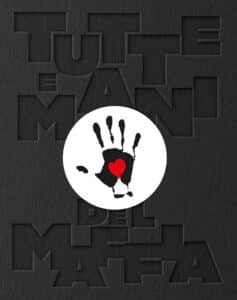

WONDERFUL REVIEW OF THE BOOK TUTTE LE MANI DEL MAFFIA @ ZERO BOLOGNA ONLINE MAGAZINE, BY SALVATORE PAPA
Collettivo Maffia — Tutte le mani del Maffia · Rizosfera · 300 pp. · €45.00
WONDERFUL REVIEW OF THE BOOK TUTTE LE MANI DEL MAFFIA @ ZERO BOLOGNA ONLINE MAGAZINE, BY SALVATORE PAPA
To understand what Maffia was, you have to start with something that today seems almost difficult to imagine: in the mid-Nineties, inside a former industrial warehouse near Reggio Emilia’s railway station, one of the most important venues in Italian club culture takes shape. Not a traditional nightclub, not a social centre, not simply a concert hall, but a space where jungle, trip hop, dub, drum’n’bass, hip hop, experimental graphics, B-movie cinema, radio, cyberpunk and a considerable number of people all converged — people convinced that even from the provinces you could still speak to the rest of the world.
Tutte le mani del Maffia, published by Rizosfera, tells this story. The book — over 300 pages of photographs, flyers, graphics, testimonies and archive materials — reconstructs the birth and evolution of the club that opened in 1995 at viale Ramazzini 33, seeking to explain how it managed, within a few years, to establish itself permanently within the international circuit of electronic music and underground cultures.
Maffia did not emerge from nothing. Behind the project there was already a network of people coming from the experience of Red’ko and the Kom-Fut Manifesto collective: DJs, graphic designers, musicians, radio presenters and promoters who in the early Nineties began building events around electronics, industrial, dub, hip hop and the countercultures.
The book follows precisely this transition, moving from an almost artisanal scene to an increasingly organised structure. In Maffia’s first season, names such as DJ Food, Herbaliser, Coldcut, DJ Vadim and Funki Porcini were already passing through — artists connected to the Ninja Tune universe and to that moment when trip hop, breakbeat, dub, jazz and electronics began to blend in new ways. In parallel, the Maffia Sound System and the Institute of Dubbology were born — an internal structure that would allow the club to organise bookings and tours independently, creating direct connections with British labels and scenes.
One of the episodes recounted in the book neatly captures the spirit of those years. In the summer of 1996, Paolo Davoli and Luca “DJ Rocca” Roccatagliati — two of the central figures of Maffia — are in London and walk into a record shop in Soho saying they are “from Maffia.” The owner, Keiron B of Atlas Records, initially thinks they mean the actual Mafia. When he realises they are talking about an underground club in Reggio Emilia, his response is: “Where the fuck is Reggio Emilia?” From that encounter a lasting collaboration with Atlas would be born.
But alongside London, the book’s stories also take in Bristol, Berlin, Tokyo and New York — cities connected to Reggio Emilia through continuous exchanges between labels, radio stations and underground scenes.
In the years that followed, Goldie, Amon Tobin, DJ Krush, Talvin Singh, Howie B, Fatboy Slim, Peshay, Photek and A Guy Called Gerald all passed through Maffia. Some of the book’s most interesting pages are devoted to the Ninja Tune nights and the English drum’n’bass scene, told by those who organised and lived them.
There is also another element that today seems very distant: between 1997 and 1999, Rai Radio 2 broadcast live from Maffia almost every Saturday night. In a period before streaming and social media, those broadcasts became one of the very few ways to hear certain DJ sets and certain sounds in Italy that until then had circulated almost exclusively through record shops, mixtapes and specialist magazines.
Considerable space is also dedicated to the club’s visual identity. The graphics of Gabriele Fantuzzi — flyers, posters, layouts, the logo of the hand with the heart — document a moment when desktop publishing, rave culture, experimental typography and digital collage were simultaneously transforming both visual communication and electronic music.
Despite all this, however, the book seeks to avoid easy nostalgia. Damir Ivic, in the introduction, states it immediately: «The past does not return. To be absolutely clear: it does not return.» And shortly after he adds what was perhaps truly the centre of Maffia: «Maffia above all was a place where there was a thirst for the future.»
Rather than turning the club into a relic, Tutte le mani del Maffia attempts to reconstruct the workings of a scene: how it is born, how it organises itself, how it manages to connect a provincial city to an international circuit, and how certain cultural experiences can, even for just a few years, produce an imaginary world far larger than the place in which they are born.
Click here for the Book


